Together5 min read
How to Choose a Movie Together Without Arguing or Endless Scrolling
Choosing a movie together is a strange little argument. Everyone wants the night to start. Nobody wants to be the person who picked wrong. So the conversation circles, the catalog stays open, and the film you would have enjoyed at the beginning is still unwatched.
This page is about the part that happens between people. Shrinking a huge catalog is its own job, and it is written up in how to decide what movie to watch. What follows is how two or more people land on one title without turning it into a trial.

Most of the fight is about the process
It looks like a disagreement about a movie. Often it is a disagreement about who is exposed. One person keeps naming titles and collecting the nos. Another stays vague, because a vague person cannot be blamed. A third has a film in mind and hears every other idea as a rejection.
Until the process is shared, every suggestion is a small test of someone's taste. People defend harder than they need to, or they give up and say anything is fine. Anything is fine is rarely a preference. It is a way to leave the decision in someone else's hands.
Decide what a yes means
A lot of these arguments are people using yes for different things.
- I want to watch this tonight
- I can sit through it
- I do not want to be difficult
Ask for the first one. A pile of films people can sit through produces something that starts and then loses the room to phones. A pile of I do not want to be difficult produces the same safe film as last time.
A useful yes is a movie you would start, not a movie you would tolerate.
Agree the rules before anyone names a film
This takes about a minute. It saves the next twenty. Say it once, out loud, before a single poster.
- 1
Who has a say
Everyone who will actually watch, not everyone who happens to be in the apartment. A person leaving after the trailer does not need a veto.
- 2
What agreement means
Everyone, or most of the room. For two people, most of the room is both of you. For a few friends, waiting on a unanimous favorite is how you rewatch something harmless. The friends version of that rule is a movie picker for friends.
- 3
The backup, chosen now
Shortest film left, a coin flip, or whoever did not choose last time. Pick the backup while everyone is still pleasant. You will not invent a fair one later.
Couples get stuck in a narrower version of the same rules, usually with one person holding the remote. That case is a movie picker for couples.
Take the performance out of the pass
Same short list for everyone. Each person marks yes or no without explaining. Then you compare. The overlap is the decision.
Narrating during the pass lets the first confident opinion become the group's taste. People edit a yes into a maybe because they do not want to argue about a musical, a subtitle, or a film someone already dismissed. A few quiet minutes are the point.
How big that list should be, and why the first real overlap wins, is the practical half of how to decide what movie to watch. Use that when the catalog is the problem. Stay here when the people are.
Read the overlap, then stop
If everyone marked the same film, play it. Do not go looking for a slightly better one. You were searching for agreement, and you have it.
If most of the room said yes and one person said no, ask which kind of no it is. A real no — I will not enjoy this, or I have seen it and I do not want to sit through it again — should count. A soft no that means I had a different favorite can yield. Pretending those are the same answer is how someone spends the film on their phone.
If the room splits into two moods, do not average them into a third film nobody named. Choose the mood first. Light or heavy. New or familiar. Then pick inside the mood that won.
If the overlap is empty, use the backup you already chose. Opening another app is a new decision, which is the thing you were trying to finish.
When you should stop choosing one film
Some nights the overlap is empty because the tastes are actually different, not because the process failed. Forcing a compromise film every time teaches people to fake the next yes.
Take turns on purpose. Their lane this time, yours next, written down so it is not a vague promise. The person whose turn it is still brings something the other can sit through. A turn is not a license to program a film the room will endure out of politeness.
You can also split the evening without calling it a failure. One short film everyone can stand, and the heavier one waits for another night. That is still a decision.
A tool only helps if it keeps the rules
You can run all of this with a note. The list has to be shared, the marks have to stay private until everyone is done, and something visible has to count as finished.
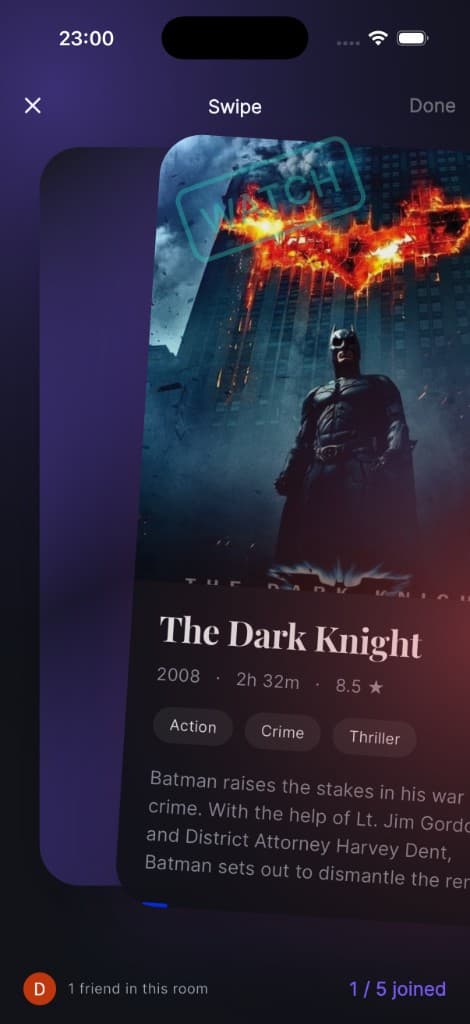
Synema is built for that pass. Someone opens a room and invites the people they are watching with. Everyone swipes through the same movies on their own phone. When everyone swipes right on the same movie, it is a match. If you are comparing that job with a streaming search or a diary, best movie picker apps keeps them apart.
It will not referee two people who want different kinds of evening, and it will not replace a diary of everything you have seen. Choosing tonight and logging it later are different jobs. Synema and Letterboxd sit on opposite sides of that line.
Common questions
What if someone says they do not care?
Treat that as I will not name a film, not as any film is fine. Ask them to mark the list anyway, with a real yes or no. People who do not care out loud often care at minute twenty.
Should one person just pick, to save time?
Sometimes, if you agreed to that before the scroll started. A surprise you pick, in the middle of the argument, hands them the blame along with the remote. A planned turn is different from giving up.
How is this different from the couples and friends guides?
Those pages are the specific stall. One partner stuck with the remote, or a group chat that never lands. This page is the shared part underneath both. If it is just the two of you, start with the movie picker for couples. If the chat is the problem, start with the movie picker for friends.
Stop debating. Start watching.
Same list. Private swipes. A movie when you actually agree.
Synema keeps the yeses honest and ends the search when the room overlaps.